How I Got Band 7.5 in IELTS in Just 20 Days: My Exact Strategy for All Four Modules
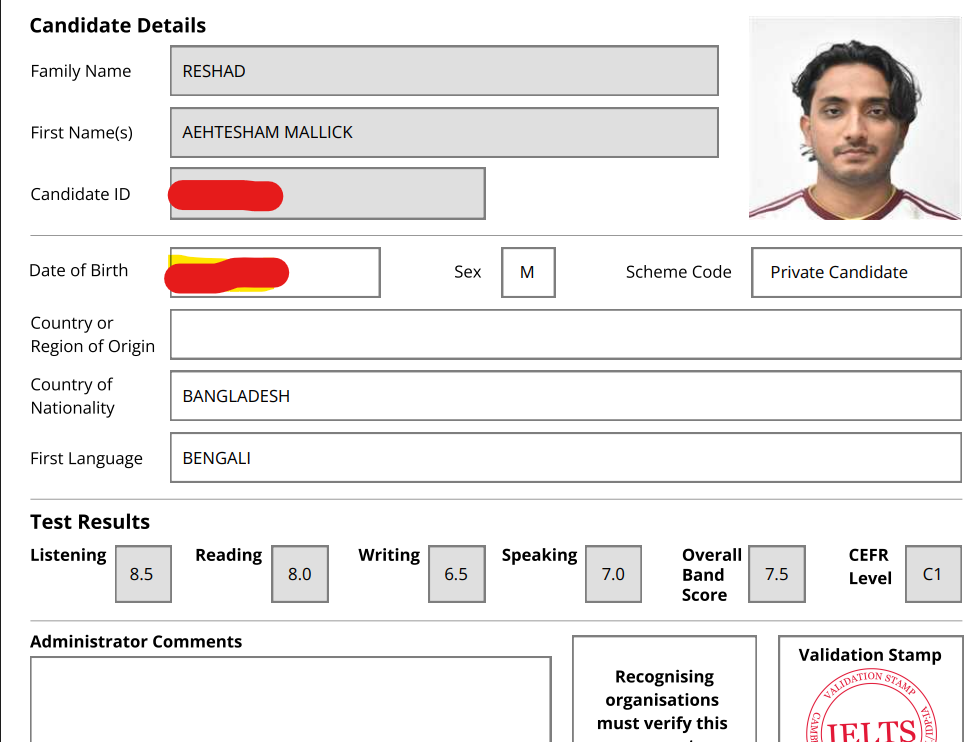
20 days, no guesswork: Listening 8.5, Reading 8, Writing 6.5, Speaking 7. Reading was my weakest module, so I stopped taking full tests and drilled the three question types that kept beating me. Here's the whole plan.

The short answer
I prepared for 20 days (September 9 to September 29) and scored an overall band 7.5 (CEFR C1): Listening 8.5, Reading 8, Writing 6.5 and Speaking 7. I did it by treating IELTS like a system rather than a test of luck:
- Diagnose first. One practice test per module showed me listening was fine (7) and reading was not (6).
- Reading, 6 → 8: I drilled my three weakest question types until I stopped getting them wrong.
- Listening, 7 → 8.5: practice wasn't enough, so I added specific test-taking tactics.
- Writing, 6.5: AI feedback on every Task 1 and Task 2 answer to fix grammar and improve phrasing.
- Speaking, 7: daily mock interviews with ChatGPT Voice Mode acting as a strict examiner.
The key idea: let Listening and Reading carry the average, and get Speaking and Writing to a safe level.
Step 1: Understand the test before you study
The very first thing I did was watch some informative videos about the IELTS exam process, including details about each module, timings, and marking criteria, to become familiar with the test format. After reviewing the details, I felt listening and reading would be relatively easy for me.
Step 2: Take a diagnostic test (and get a reality check)
I decided to take a listening practice test first, just to check if my assumption was correct. I discovered that Engnovate provides Cambridge IELTS questions with an excellent exam interface. I took one of their listening tests and, boom, scored a 7 on my very first attempt.
That listening score boosted my confidence and encouraged me to attempt a reading test right away. However, I scored only a 6, which left me feeling a bit frustrated. It was a clear reality check: reading was going to be more challenging than I had anticipated.
My strategy for an overall band 7+
From YouTube videos, I realised that both speaking and writing take significant time to develop, and that a 7 in either module is considered exceptionally strong. So to secure an overall band of 7+, my strategy was clear: excel in listening and reading to pull up my average, while aiming for a solid 7 in both speaking and writing.
| Module | First practice test | Real exam | What changed it |
|---|---|---|---|
| Listening | 7 | 8.5 | Test-taking tactics |
| Reading | 6 | 8 | Drilling weak question types |
| Writing | — | 6.5 | AI feedback on every essay |
| Speaking | — | 7 | Daily ChatGPT mock interviews |
| Overall | — | 7.5 | Listening and Reading carried the average |
IELTS Reading: how I went from 6 to 8
With this goal in mind, I began my targeted preparation on September 9, exactly 20 days before my exam on September 29. Since fixing my reading performance was the top priority, I focused on identifying my weak areas, specifically the question types I struggled with most, so I could practise them systematically.
IELTSbiz was immensely helpful here, because it lets you practise one question type at a time. (Full disclosure: I'm also the developer behind IELTSbiz.) Three types proved particularly challenging and time-consuming for me:
- Matching Headings
- Matching Information
- True / False / Not Given
I practised these extensively. Over time I grew comfortable with their nuances and started getting almost every answer correct. Feeling prepared, I attempted a full reading test again, and this time my score jumped to an 8, which is exactly what I got in the real exam.
IELTS Listening: from 7 to 8.5 with tactics, not just practice
Next came listening, where I was consistently scoring around 7 or 7.5. Deep down, I knew that a high overall band needed listening at 8 or above. Surprisingly, simple practice wasn't enough to reach the top bands. Specific test-taking tactics were what made the difference. The Lelie IELTS YouTube channel gave me the strategies that worked:
- Read complex questions more than once before the audio starts.
- Identify and mark keywords quickly.
- Pre-read long multiple-choice options before the audio plays, so you know what you're listening for.
Once I used these tactics, the results were immediate: my listening scores moved from 7–7.5 to a consistent 8–8.5. I was thrilled to see such solid progress across both receptive skills. In the real exam I scored 8.5.
IELTS Writing: a 6.5 with AI feedback on every essay
Alongside listening and reading, I kept analysing writing content to understand the different task types and how to structure an effective response. Here again IELTSbiz helped, especially its AI writing evaluation tool, which highlighted my grammatical errors and suggested stronger phrasing for both Task 1 and Task 2.
I scored 6.5 in Writing, half a band below my target. Honestly, that's exactly why the strategy mattered: because Listening and Reading were strong, a 6.5 here didn't pull my overall band below 7.5. Writing improves the most slowly of the four, so if you have more time than I did, put it here.
IELTS Speaking: a 7 with ChatGPT Voice Mode as a strict examiner
For speaking, ChatGPT was my constant practice partner. I used Voice Mode to simulate real Part 1, Part 2 and Part 3 exam scenarios and asked it to act as a strict IELTS examiner. I would record my responses, ask for real-time feedback on my fluency, vocabulary and pronunciation, and then retry the questions using the improved expressions it suggested.
This daily practice reduced my hesitation, expanded my topic-specific vocabulary, and made speaking fluently feel second nature. I scored a solid 7 in Speaking.
What made the difference
By combining structured practice, targeted feedback and practical tactics across all four modules, I turned my initial weak spots into strengths. Going into exam day, I wasn't relying on luck. I had built a reliable system that gave me complete confidence in reaching my target band. Twenty days after I started, I walked out with an overall 7.5.
If you're starting out, my advice is the same order I followed: understand the test, take one honest diagnostic, then spend most of your time on the specific things that are costing you marks.
Frequently asked questions
Can you get band 7.5 in IELTS in 20 days?
Yes. I started targeted preparation on September 9 and sat the exam on September 29, 20 days later, and scored an overall 7.5 (CEFR C1): Listening 8.5, Reading 8, Writing 6.5 and Speaking 7. It worked because I spent those days on my specific weak spots instead of repeating full practice tests.
How can I improve my IELTS Reading score from 6 to 8?
Stop relying only on full practice tests. Find the question types you get wrong most often, practise them on their own until you answer almost every one correctly, and then go back to full timed tests. For me those types were Matching Headings, Matching Information and True/False/Not Given, and drilling them took my reading from band 6 in practice to band 8 in the real exam.
Which IELTS Reading question types are the hardest?
It depends on the person, but Matching Headings, Matching Information and True/False/Not Given are the most commonly difficult because they are time-consuming and test fine differences in meaning. They were the three that held my score back.
How do I get 8 or more in IELTS Listening?
Practice alone usually plateaus around 7 to 7.5. To break through, use test tactics: read complex questions more than once, underline keywords quickly, and pre-read long multiple-choice options before the audio starts. Adding these moved my practice scores from 7–7.5 to 8–8.5, and I scored 8.5 in the real exam.
Can I practise IELTS Speaking with ChatGPT?
Yes. Use ChatGPT Voice Mode, ask it to act as a strict IELTS examiner, and run full Part 1, Part 2 and Part 3 simulations. Ask for feedback on fluency, vocabulary and pronunciation after each answer, then retry the same question using the better expressions it suggests. Daily practice like this got me a 7 in Speaking.
Which IELTS modules should I focus on to get a high overall band?
Listening and Reading are the easiest to push to 8 or above with targeted practice, and they lift your overall average. Speaking and Writing take longer to build. My Writing was 6.5, but Listening 8.5 and Reading 8 carried my overall band to 7.5.
What resources did you use to get band 7.5 in IELTS?
YouTube videos to understand the test format, Engnovate for Cambridge IELTS listening and reading tests in a real exam interface, IELTSbiz for question-type practice and AI writing evaluation, the Lelie IELTS YouTube channel for listening tactics, and ChatGPT Voice Mode for speaking practice.